


Cambria design shown: Delamere™
Victoria Sass of Prospect Refuge Studio reinvented a lakeside cabin in Minnesota, featured in Cambria Style magazine, that is part of a larger family compound. Here, Cambria Style talks with the designer about her Midwestern values and how she helps clients make brave choices through her use of totems, an element from the natural world (never a design buzzword) that helps direct her aesthetic choices.
Where does the story of a home begin for you: the client, the architecture, or something less obvious?
I think we start with the most challenging piece, whatever that is. The stickier the problem, the better the end result is going to be. I think any great creative will tell you the same. An easy problem never yields brilliant results because it has a simple solution, but a complicated problem yields unexpected results and that’s usually the best.
How do you design a space that feels both collected and completely new?
I think that our culture right now chases good taste. There are so many designers and homeowners who want rooms to be tasteful and nothing else. You should have good taste in your project, but if every single thing is perfect and has no conversation around it, then you end up with a flat look. You’ve swung too hard in the other direction. When you get a space that looks natural and collected, it’s because you’ve incorporated a few things that are challenging.
What’s one design decision that consistently shapes how a space feels, not just how it looks?
People don’t always recognize the power that the volume of a space has on them and they’re not asking questions or experimenting in that realm as much as they could be. I’m sitting in an old house right now with 12-foot ceilings and this house has a very specific presence that other houses don’t. Skinny rooms with tall ceilings feel like a certain era that we don’t do anymore.
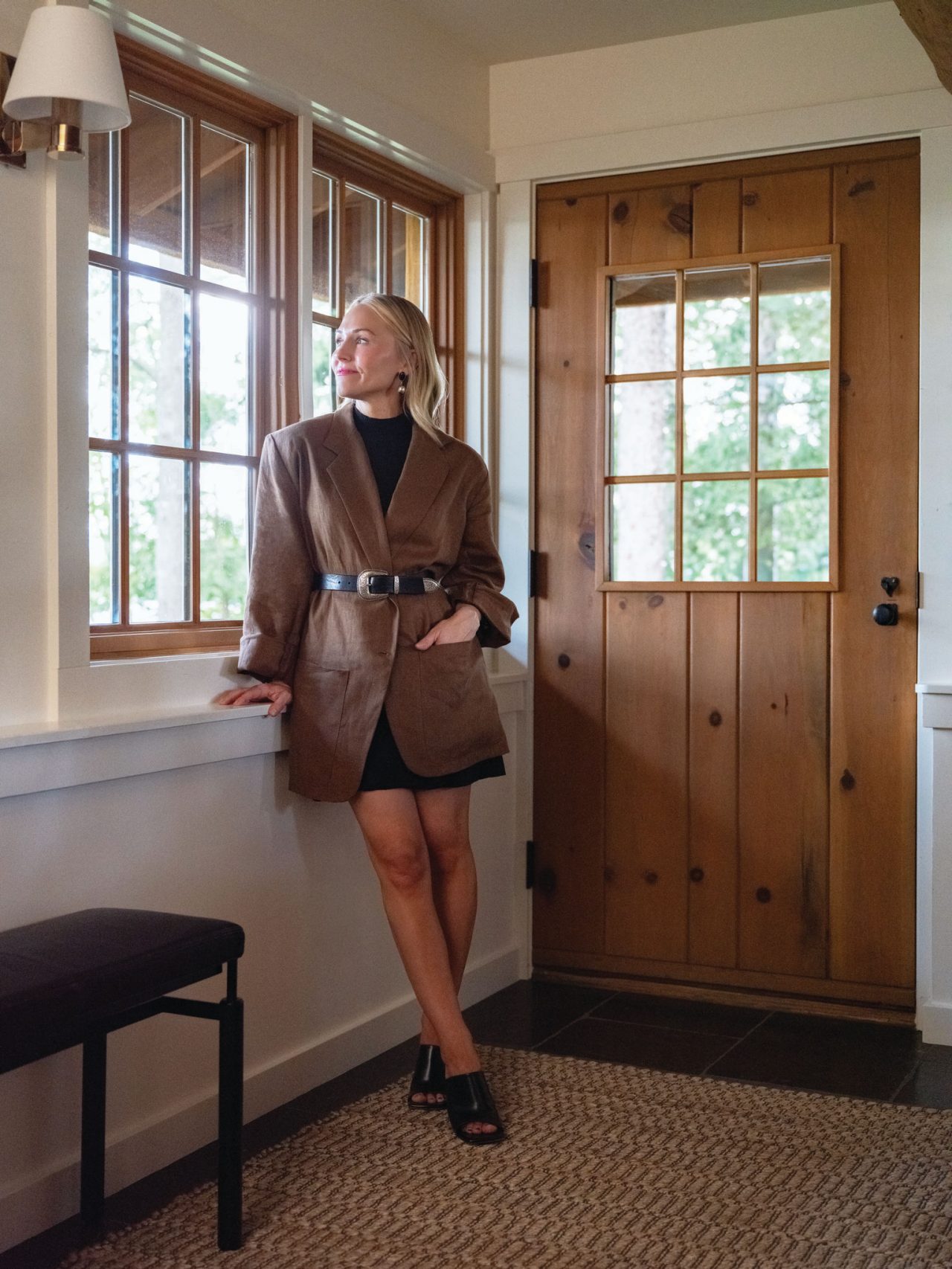
How do you balance regional influence—your Midwestern perspective—with creating spaces that feel globally relevant?
The world is naturally getting more globally informed, so I don’t have to work very hard at that side of it. I actually think it’s more important that I focus on the regional impact and voice; in my case, the Midwestern voice. It’s effortless to be global; I think it’s really hard to be regional and it takes mindfulness.
When working with existing homes, how do you decide what history to preserve versus what to reimagine?
The thing that feels the most challenging on day one is usually the thing I’m most interested in preserving because the reason it feels challenging is because it holds the most emotion and that can feel overwhelming. In this project, it’s the wood logs. They’re beautiful, but they have a big voice so we had to figure out how to celebrate them without having them be the only thing in the room.

The stone fireplace is original to the cabin. The upholstered chairs pair perfectly with the homeowners’ organic-shaped black polished ottoman.
Where do you think detail matters most, and where can you let things be a little imperfect?
It depends on the homeowner’s tolerance for imperfection versus what will make them feel deeply uncomfortable. I think letting things be imperfect is good up to a point, but if it starts making you dislike your home, then you’ve probably gone too far.
What’s a design move that subtly changes how someone lives in a space day to day?
Circulation is a really interesting thing that people could experiment with more. It doesn’t require money, time, or energy. Just move your furniture around; move your chair from one side of the room to the other or move a lamp from this chair to that chair. It’s wild how that can transform the whole energy of a room. Disrupt your environment—even just the tiniest little bit—and all of a sudden, you’ll see everything again.
How do you guide clients toward braver, more personal choices without losing their sense of comfort?
That’s 100 percent why we have totems, because when people know that there’s a rhyme and a reason for why we’re proposing something outside their comfort zone—there’s a precedent and it makes sense with the story—then you can step bravely into that decision.
How do you reinterpret the past in a way that feels current?
You have to be familiar with the past to reinvent it. In the beginning of a project, we identify the features that we’re going to preserve and not touch. It’s establishing early on what those things are that are off-limits, but then saying that anything else is fair game. You can’t feel like you have to preserve everything. It’s just boundary setting.
Discover More
Get our beautifully curated collection of lifestyle stories, interior design trends, and expert advice sent straight to your home and email inbox with a complimentary subscription to Cambria Style magazine.
Ready to explore Cambria quartz designs in person? Contact a Cambria consultant or use our retail locator to find a professional in your area for project support and planning, material selection, or visualizing what’s possible.
Explore the #MyCambria Gallery to see how others transformed their spaces and follow us on social media.


